The Rome Colosseum, whose original name is the Flavian Amphitheatre, was built between 72 and 80 AD by the Flavian dynasty. With room for between 50,000 and 80,000 spectators, it was the largest amphitheatre in the Empire and the stage for gladiator combats. This is the story of how it was raised, what went on inside and how it has reached the 21st century still standing.
Emperor Vespasian ordered the amphitheatre built around 72 AD on the ground where Nero had raised his lavish palace, the Domus Aurea, and his artificial lake. The gesture was political: giving the people of Rome back a space a tyrant had taken for himself. The work moved fast thanks to the wealth seized in the campaigns in Judea.
Vespasian did not live to see the building finished. It was his son Titus who inaugurated it in 80 AD with a hundred days of games. The third Flavian emperor, Domitian, completed the upper level and excavated the underground. From the three emperors of this family —the Flavians— comes the monument's original name: the Flavian Amphitheatre. The name "Colosseum" came later, probably from the nearby colossal statue, the Colossus of Nero.
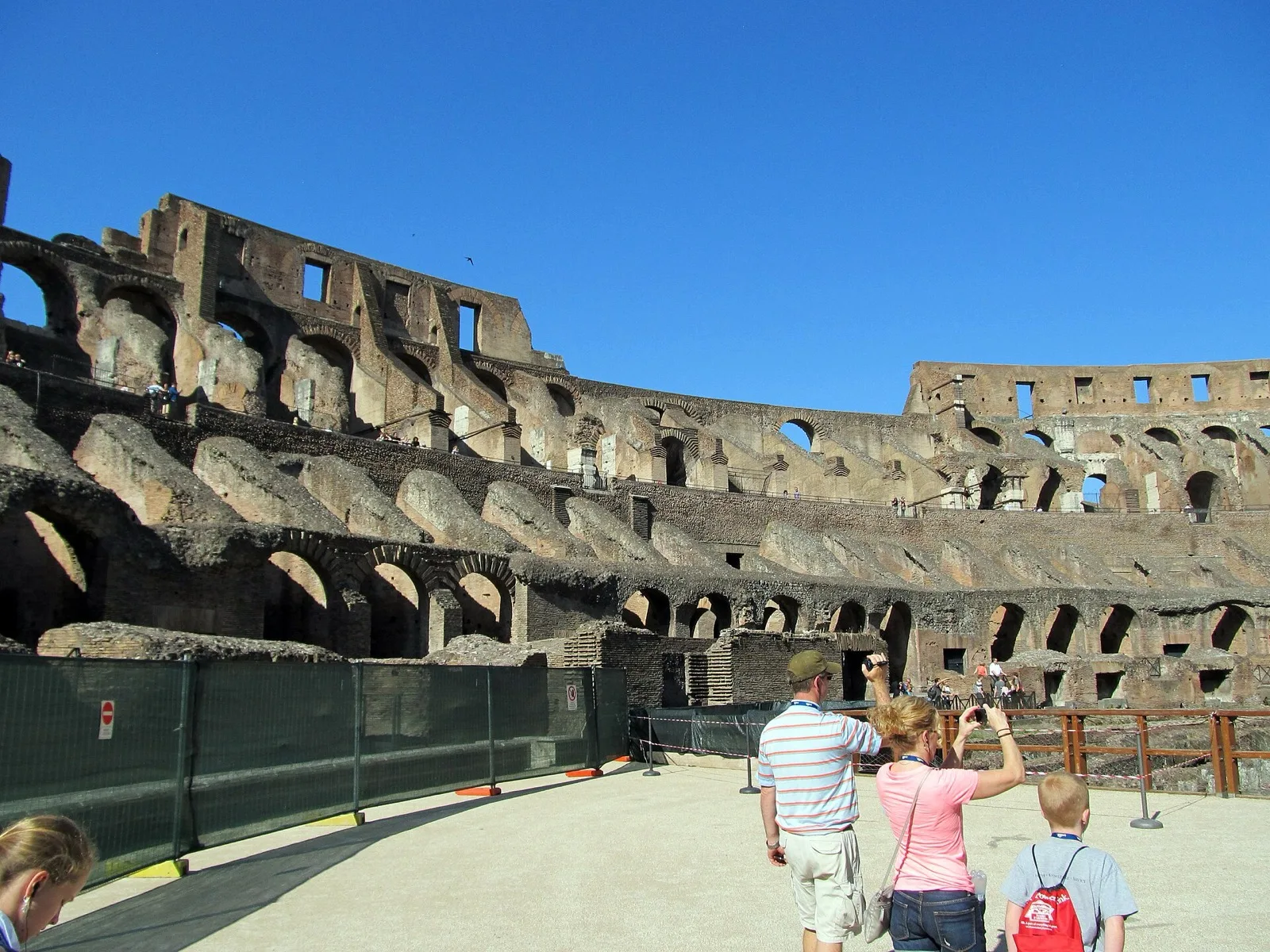
The Colosseum measured roughly 188 by 156 metres and rose about 48 metres high. Its capacity is estimated at between 50,000 and 80,000 spectators, depending on the source, which made it the largest amphitheatre in the Roman world. A system of 80 arches and numbered passageways, the vomitoria, allowed the stands to fill and empty in a few minutes.
The public was seated according to social rank: the emperor and the senators in the front rows, next to the arena; the knights and citizens in the middle tiers; and the women and the humblest classes in the upper tier, the furthest away. A large retractable awning, the velarium, shaded part of the public from the sun.
The Colosseum was built for spectacle. The most famous were the gladiator combats (munera) and the wild-beast hunts (venationes), in which animals brought from across the Empire were displayed and killed. Public executions were also held and, according to ancient sources, in its early years possible naumachiae, naval battles staged with the arena flooded, before the hypogeum was built beneath the floor.
The games were free for the people and were funded by the emperors as a tool of power: the famous "bread and circuses". If you want to dig deeper into who the stars of the arena were, read our guide on the gladiators of the Colosseum.
With the fall of the Western Roman Empire, the shows gradually disappeared: the last documented gladiator combats date to the 5th century and the hunts ended in the 6th. The amphitheatre fell into disuse. Through the Middle Ages it suffered several earthquakes —especially the one in 1349— that brought down much of its southern outer ring, and for centuries it served as a quarry: its stone and iron were reused to build palaces and churches in Rome.
Protection of the monument began to be taken seriously in the 18th century, when Pope Benedict XIV consecrated it to the memory of the Christian martyrs and halted the plundering. Restorations have followed ever since, stabilising the structure. Today the Colosseum is a World Heritage Site, one of the New Seven Wonders of the World and the most visited monument in Rome, with some 12–14 million visitors a year.
The best way to understand the Flavian Amphitheatre is to walk through it with a guide who tells you what happened on each tier. Guided tour of the Colosseum, Forum and Palatine, skip-the-line, from €49.
See the guided tour from €49 →
⏳ The Colosseum sells out daily in high season. Book ahead · free cancellation up to 3 days before.
Prefer to go on your own? Tickets with audio guide from €39.90 →
It was built between 72 AD, under Vespasian, and 80 AD, when his son Titus inaugurated it with a hundred days of games. Domitian, the third emperor of the Flavian dynasty, later added the upper level and the underground. Hence its original name: the Flavian Amphitheatre.
Estimates range between 50,000 and 80,000 spectators. The public was seated by social rank: the emperor and the senators in the front rows and the humblest classes in the upper tier. It was the largest amphitheatre in the Roman Empire.
Gladiator combats and wild-beast hunts, plus public executions and, in its early years, possibly naumachiae or naval battles with the arena flooded. They were free for the people and served as a political tool for the emperors.
After falling out of use, it suffered earthquakes and was used as a quarry for centuries, which explains why part of its outer ring is missing. Its preservation improved from the 18th century, when it was consecrated to the memory of the Christian martyrs. Today it is a World Heritage Site.
Build your day-by-day itinerary —what to see, how long to stay and where to eat— with our free Trip Planner, no signup.
Plan your trip to Rome →